
Do you remember when city life meant long traffic jams, overflowing garbage bins, and endless queues at government offices? We would just accept these inconveniences as part of urban living. Those days are fading fast. With IoT (Internet of Things) becoming central to smart cities, our connection to the urban world is changing in surprising ways.
You may have heard terms like “connected infrastructure,” “smart traffic lights,” and “digital governance.” But what do these really mean for us? Let’s talk about it like we’re having a casual conversation over coffee.
What exactly is a smart city?
Think of a smart city as a place where technology and data work together to make life easier. Traditionally, cities relied on manual systems, traffic police at intersections, paper-based records in offices, and fixed schedules for utilities.
Smart cities change the game. They use IoT devices, sensors, cameras, meters, and connected gadgets to collect and process data in real time. This allows cities to respond instantly to challenges.
Here are the key points:
- Efficiency: Resources like electricity and water are managed intelligently, reducing waste.
- Connectivity: Millions of devices communicate seamlessly, from streetlights to public transport.
- Sustainability: Smart systems reduce pollution and energy consumption.
- Convenience: Citizens enjoy faster services, safer streets, and smoother mobility.
Think of it as moving from a chaotic single-lane road to a multi-lane expressway where everything flows smoothly.
What is the secret sauce behind smart cities?
You probably already use some IoT-driven services, maybe a metro card that tracks your travel, a smart parking app, or a digital payment system. But this is just the beginning. IoT makes cities truly “intelligent.”
Here’s how:
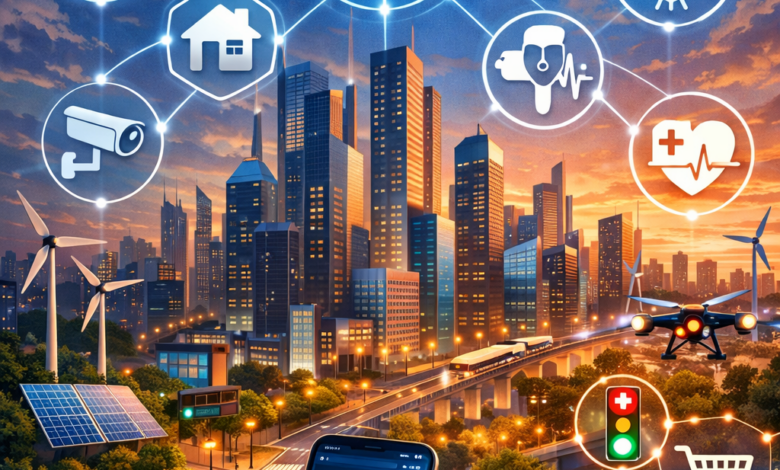
- Smart traffic management: Sensors detect congestion and adjust signals automatically.
- Connected healthcare: Hospitals monitor patients remotely and share data instantly.
- Waste management: Smart bins alert authorities when they are full.
- Energy efficiency: Smart grids balance electricity demand and supply in real time.
Imagine this:
Your car gets a notification about traffic ahead and suggests an alternate route. Streetlights dim automatically when no one is around, saving energy. A water meter detects leakage and alerts the municipal department instantly. All this is possible because IoT eliminates delays and enables real-time communication.
How will smart cities affect your everyday life?
Smart cities will change your daily routine in ways you might not expect:
- Smarter homes: Apartments connected to city grids can optimize electricity and water usage.
- Healthcare that cares: Doctors can monitor patients remotely, and emergency services can respond faster.
- Better entertainment: Public Wi-Fi and connected venues make streaming and gaming seamless.
- Smart transportation: Self-driving cars, connected buses, and intelligent traffic signals reduce travel time.
- Digital governance: Citizens can pay bills, file complaints, and access services online without standing in queues.
This isn’t just a step forward, a major leap toward convenience and sustainability.
Why are smart cities growing fast, especially in India and the USA?
Let’s talk geography for a moment.
India: The government’s Smart Cities Mission is driving IoT adoption in urban areas. Cities like Pune, Bengaluru, and Ahmedabad are already using smart traffic systems, digital governance platforms, and connected utilities. This helps small businesses and citizens in remote towns access the same services as those in metros.
USA: Smart city initiatives are transforming places like New York, Chicago, and San Francisco. IoT is powering connected cars, smart grids, and advanced healthcare systems. Companies are experimenting with automated delivery drones, AI-driven policing, and virtual workplaces.
So, whether you are in Delhi or Dallas, you can see the future of urban living unfolding right now.
What are the hurdles nobody talks about?
No tech revolution is without challenges. Smart cities face a few:
- High costs: Building IoT infrastructure and smart grids requires heavy investment.
- Device compatibility: Not all legacy systems can integrate with IoT.
- Cybersecurity risks: More connected devices mean more opportunities for hackers.
- Urban-rural divide: Big cities get access first, while smaller towns may lag.
But progress continues. As costs decrease and governments invest, these issues will improve just like they did with mobile internet and cloud computing.
What does the future look like with smart cities?
The exciting part about smart cities is not just one cool gadget; it’s how everything connects. We are moving toward a system where every part of urban life, from traffic to waste management, works together seamlessly.
Here’s what’s next:
- AI-powered governance: Systems that predict citizen needs and respond proactively.
- Smart energy: Cities running on renewable energy managed by IoT-enabled grids.
- Immersive AR/VR: Public services and education delivered through virtual platforms.
- Predictive healthcare: IoT devices detecting health issues before they become emergencies.
If the internet was the first digital revolution, smart cities are the second — and they will affect everything.
Why should you care about smart cities?
You might not think you need IoT-driven services now, but in a few years, every urban system will rely on them. It’s similar to when everyone moved from paper-based records to digital platforms. Once you experience it, you won’t want to go back.
Smart cities aren’t just about convenience. They are about creating safer, greener, and more efficient urban spaces.
Final thoughts
Smart cities and IoT are not just futuristic ideas; they are becoming part of our lives today. The true impact will be how seamlessly they fit into our daily routines, much like how we currently use Wi-Fi without thinking about it. This is more than just technology. It is a move toward a smarter, more sustainable world.
FAQs about smart cities and IoT
Q1. Is a smart city just about technology?
Ans: No, it’s about improving quality of life through efficiency, sustainability, and connectivity.
Q2. Will my city become smart soon?
Ans: Major cities in India and the USA are already adopting IoT. Smaller towns will follow gradually.
Q3. How does IoT improve transportation?
Ans: It enables real-time traffic management, connected vehicles, and safer public transport.
Q4. Is IoT safe for urban living?
Ans: Yes, but strong cybersecurity measures are essential to protect data.
Q5. How fast is IoT adoption worldwide?
Ans: By 2030, most major cities will integrate IoT into core infrastructure.
Q6. When will smart cities be common in India and the USA?
Ans: By 2026, many urban centers will have full IoT integration, with rural areas following soon after.
For more information visit on our website : Dolphin Techknology