

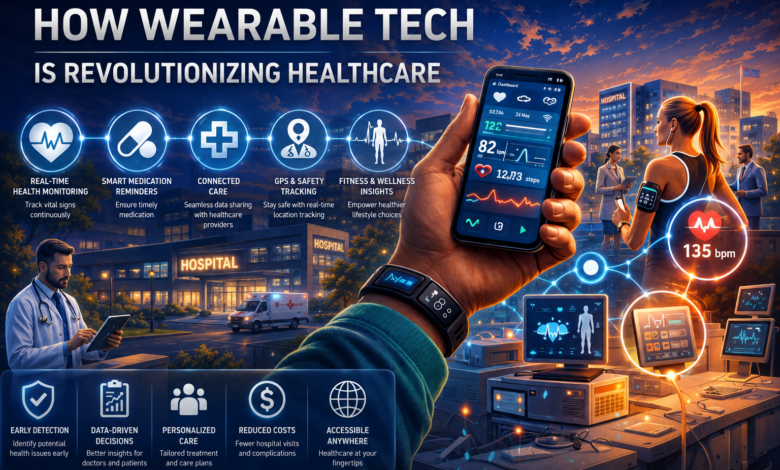
Have you ever looked at your smartwatch and thought, “Wow, this little device knows more about me than my best friend”? We live in a world where our wrist, shirt, shoes, and even our pillow track our heartbeat, sleep, stress levels, and daily steps. And surprisingly, we’re okay with that.
Wearable tech has become part of our lives, and many of us don’t realize how much it is changing healthcare. I don’t mean in a sci-fi way with robot doctors, but in a real way that helps people live longer, spot health issues sooner, and make informed health choices based on real data instead of guessing.
Let’s explore how wearables moved from being just “fancy pedometers” to becoming a major force in pushing tech revolutionizing healthcare into the future.
Why wearable tech is suddenly everywhere?
Let’s discuss why wearable health tech is becoming so popular right now.
There are a few main reasons:
- People want to take charge of their health. Tracking their data gives them that control.
- Technology is becoming highly accurate, nearly at medical standards.
- Healthcare systems around the world are overwhelmed, making prevention more important.
- The pandemic raised health awareness and made telehealth more common.
- Prices have fallen, and many more people are using these devices.
Whether it’s from Apple, Fitbit, Samsung, Oura, Garmin, or even wearables designed by hospitals, the goal is the same: to move healthcare from being reactive to proactive.
How does wearable tech help with early detection?
Wearable technology is very helpful for spotting health issues early. Many modern devices can detect problems before you notice them. For example:
- Apple Watches can find atrial fibrillation (AFib) in many users who didn’t know anything was wrong.
- Continuous glucose monitors (CGMs) help diabetics quickly see dangerous sugar spikes.
- Smart rings and bands can detect drops in oxygen and changes in breathing, sometimes even suggesting an infection before symptoms appear.
Imagine your watch gently alerting you, “Hey, your heart is racing; maybe check that out?” This is what early detection looks like in everyday life, and for some people, it can save their lives.
How does remote patient monitoring help patients from home?
This is important news for hospitals and even more important for patients. Doctors can now monitor a person’s:
- heart rate
- oxygen levels
- glucose
- mobility
- sleep
- blood pressure
- stress patterns
…without requiring them to visit the clinic every week.
This process is called remote patient monitoring (RPM), and it’s changing the game for:
- seniors
- chronically ill patients
- post-surgery recovery
- people in rural areas
- patients receiving home care
Hospitals appreciate it because it reduces the number of patients who need to be readmitted. Patients like it because no one enjoys waiting in a clinic among old magazines.
What personalised healthcare can you get with wearable tech?
If you’ve tried a “one-size-fits-all” diet, you know it rarely works. Wearable technology solves this by giving you data based on your body, not on an average person.
You can learn about:
- How do you sleep?
- How does your mood change?
- How does your heart react to stress?
- How does your body handle workouts?
- How much recovery do you need?
This is personalized healthcare. Doctors have always wanted to provide this level of care, but didn’t have enough real-time information before.
Now, health feels less like a mystery and more like a clear path.
How is your health turning into a game through wearable tech?
People enjoy having goals, earning rewards, and keeping track of their progress. Wearable devices like fitness trackers recognized this early on. Now we have:
- Daily step goals
- Move rings
- Sleep scores
- Leaderboards
- Reward badges
- Mindfulness streaks
When we turn tech revolutionizing healthcare into a game, something great happens: people stick with it. Sometimes, the best encouragement comes not from a doctor, but from your smartwatch asking, “You only moved for 3 minutes today. Everything okay?” Ouch, but it gets your attention.
How will it help you with mental health tracking?
Wearable devices can greatly help with mental well-being. They have features like stress sensors, heart rate variability measurements, breathing reminders, emotion tracking, and sleep monitoring. These tools help people understand:
- Why do I feel burnt out today?
- Why was I anxious last night?
- Why is my sleep quality suddenly poor?
By recognizing patterns, people can improve their daily routines, reduce anxiety, and build healthier habits. It’s like having a small therapist on your wrist, without any awkward silence.
How is fitness becoming more data-driven with wearable tech?
Those days are gone when you have to wonder if you had a good workout. Wearable devices now track your important things like:
- VO2 max
- Recovery time
- Calorie burn accuracy
- Heart rate zones
- Training load
- Muscle recovery
- Hydration reminders
This technology helps athletes and people who want to stay healthy train smarter, not harder. The fitness world is now more precise and exciting than ever.
What does the future of wearable tech really look like?
Imagine this: you’re getting ready for the day, and before you even glance in the mirror, your smart patch has already checked your hydration levels, your smart ring has evaluated your stress score, and your shirt has quietly monitored your overnight breathing pattern.
You haven’t tapped a screen or opened an app; your wearables simply understand what your body needs the moment you wake up.
This isn’t science fiction.
This is exactly where modern wearable tech revolutionizing is heading: toward intelligent, intuitive, human-friendly technology that supports your health before you even ask for help.
Wearable technology is no longer just about step counting. It is growing into a powerful ecosystem that tracks your body, learns your habits, and responds to your health in real time.
How are smart fabrics and sensors transforming personal health?
When wearables first arrived, most people saw them as simple activity trackers, mainly for counting steps or checking their heart rate. They were helpful, sure, but limited. Now, we’re entering a time where technology blends seamlessly into your clothing and even your skin.
Below are the innovations shaping the next era of healthcare:
- Smart fabrics woven with tiny sensors that measure body temperature, posture, muscle activity, and more.
- Skin patches capable of tracking hydration, hormones, and glucose, all without needles or pain.
- AI-powered alerts that warn you about potential illness long before symptoms start.
- Cuff-free blood pressure monitoring that works silently throughout your day.
- Smart eyewear that reads neural signals to track focus or fatigue.
- Implantable wearables, designed to live inside your body and monitor vital signs continuously.
If today’s wearables seem advanced, the next generation will make them look outdated, like VHS tapes sitting beside a modern smart TV.
What challenges come with this rapid growth in wearable healthcare?
Let’s be realistic; while wearable tech is exciting, it isn’t perfect, and it’s important to talk about the challenges too.
Here are some areas that still need improvement:
- Privacy concerns, because your most personal health data must be protected.
- Variations in accuracy, depending on the brand, model, or sensor quality.
- Cost barriers, as many advanced wearables still feel expensive for average users.
- Information overload, where too many metrics can cause worry or confusion.
- Lack of medical approval for certain consumer devices which limits their clinical use.
Even with these challenges, the momentum is unstoppable. Wearables continue evolving into essential health companions, much like smartphones became life essentials over time.
Are wearables really reshaping the future of healthcare?
Without any doubt, the answer is yes. Wearables are already transforming healthcare from something reactive to something proactive and personalized.
They are making healthcare:
- More preventive
- More precise
- More accessible
- More data-driven
- More aligned with everyday life
Doctors are now able to see months of health patterns instead of relying on a single appointment reading. People feel empowered because they can understand their bodies better. tech revolutionizing healthcare companies push new ideas year after year, expanding what these tiny devices can do. We walk around with invisible health assistants strapped to our wrists, wrapped around our fingers, or built into our clothes, and it feels surprisingly normal now.
Frequently Asked Questions (FAQs)
Q1: What is considered wearable healthcare technology?
Ans: Wearable healthcare tech includes smartwatches, fitness trackers, smart rings, chest straps, glucose monitors, smart clothing, and medical-grade sensor patches.
Q2: Are wearable devices medically accurate?
Ans: Many FDA-approved devices are highly accurate, while consumer-level wearables vary but improve with each new generation.
Q3: Can wearable tech help detect illnesses early?=
Ans: Yes. Wearables can detect heart rhythm problems, oxygen dips, sleep issues, and even early signs of infections.
Q4: Is wearable tech safe for long-term use?
Ans: Yes, most use low-energy, non-invasive sensors designed for daily and long-term wear.
Q5: How do wearables help doctors?
Ans: They provide continuous, real-time health data, giving doctors a more complete picture of a patient’s health.
Q6: Can wearables work without a smartphone?
Ans: Some can operate independently, but most require a smartphone for data syncing, reports, and analytics.
For more information visit on our website : Dolphin Techknology




One Comment