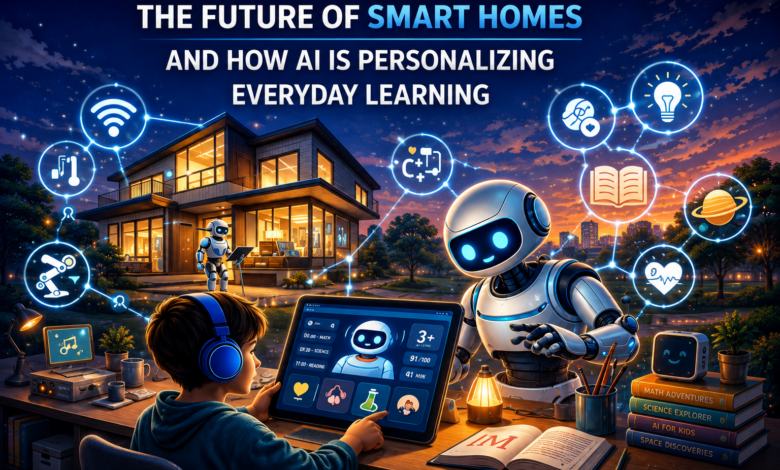
The future of smart homes and how AI is personalizing everyday learning

Imagine this, you are walking through your front door after having a long and hectic day. You entered your home, the lights dimmed to a warm glow, the temperature adjusted enough to make you feel comfortable, and a soft playlist started playing in the background. You don’t have to touch a switch or say a word; your home simply knows what you need and when.
It isn’t just a fantasy, it is the direction modern living is taking. The future of smart homes is centered around one simple idea: personalization through artificial intelligence.
Your homes are no longer simply connected. They are becoming aware, learning your habits, adapting to your preferences, and enhancing your day so that your comfort and efficiency blend seamlessly.
How did your smart homes get so smart?
When smart homes first emerged, the primary goal was automation, such as dimming the lights or locking the doors using your phone, which was impressive at the time. However, it still required effort, and you had to remember to do it.
Now, technology has advanced significantly with AI at its core, so that your home no longer just follows instructions; it anticipates them. Your home thermostat learns your preferences for room temperature, your blinds open automatically with the sunrise, and your coffee begins brewing for you as soon as your morning alarm goes off.
It will no longer be about you controlling your home; it will be your home understanding you.
What is the role of AI in your personalized living?
Artificial intelligence, or AI, is the innovation force behind the modern evolution of your homes. It can easily transform a smart gadget into a thoughtful gadget. AI learns from your daily life patterns, such as when you take a rest, when you wake up, your preferred lighting, and your usual departure times. Over time, it creates a routine just customized for you.
For example, after a few weeks, your home AI system will notice that you consistently lower the lights around 10 pm to read. One night, if you forget to turn the lights off, they will adjust automatically, saving you the hassle.
This isn’t just about your convenience; it is about intelligence that has intuition.
Are AI voice assistants starting to understand you?
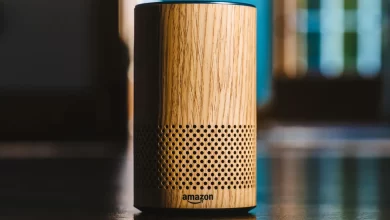
We have come a long way from having to say, “Alexa, turn on the lights,” several times before it actually works. Today, AI voice assistants are becoming smarter, friendlier, and better at understanding how you speak and the commands you give.
Now, instead of using strict or long commands, you can simply say, “It feels a bit cold or hot,” and your assistant will know what to do. You will feel that your interactions are more conversational, rather than mechanical.
These voice assistants can connect with almost every part of your home, including your lights, security, entertainment, kitchen appliances, and even your car. As the natural language technology improves, talking to your assistant will feel like chatting with digital friends rather than just machines.
Sometimes, it is easy to forget that you are speaking to software at all with the right technology.
How does AI create security that thinks ahead?
Safety is one of the key areas where AI has a significant impact. Traditional alarm systems simply wait for your problems to arise, while AI-driven systems actively work to prevent them.
These systems can recognize familiar faces, detect unusual movements, and even learn the daily patterns of your household. If something unusual happens, for example, a door opens at an odd hour, you will immediately receive an instant alert.
Some security systems utilize geofencing, which automatically locks your doors when you leave your place and unlocks them when you return. Some systems can also differentiate between your dog roaming around and a potential intruder, which helps in reducing false alarms.
The outcome of the AI security system? You will get a home that looks out for you like a vigilant friend.
Sustainability: How is AI creating smarter and greener living?
AI is not only making your life easier but also helps the planet. Smart homes play an important role in promoting sustainability. AI can monitor your energy use and will find ways to reduce waste.
Below are some examples:
- Smart thermostats like the Nest learn your schedule and adjust heating and cooling to save energy.
- Some lighting systems can change their brightness based on how much daylight there is and if people are in the room.
- Energy dashboards can show you how you use electricity, will give you tips on saving more.
Over time, these sustainable AI systems can lower your energy bills and reduce your carbon footprint. The future of smart homes will combine your comfort with conservation.
How does the technology behind smart homes actually work?
The Internet of Things (IoT) connects all the devices in your home to make your life easier. For example, your smartphone can talk to your thermostat to adjust the temperature according to your liking. Your thermostat can also work with your smart lights to change their brightness based on the time of day or your activities. Your smart refrigerator can connect to a grocery app on your phone to let you know when you are out of items and will help you make a shopping list.
The constant sharing of information creates a lot of data. Here is where artificial intelligence plays a role. AI analyzes this data to provide useful insights. Over time, your home learns your habits, which help it to meet your needs more effectively. It will track your daily routine, such as when you wake up, leave for work, or unwind in the evening, and adjust your home to improve your comfort and efficiency.
Living in a smart home is like having a digital assistant. This system will remember your preferences, adapt to changes in your routine, and get better at responding to you, making your everyday tasks simpler and more enjoyable.
Is your privacy safe in your smart home?
With intelligence comes responsibility, especially regarding privacy. AI-powered homes can rely on data from your habits, schedules, and sometimes your voice. It is important to protect this data. The tech industry is making improvements for you. Companies are creating stronger encryption, offering on-device storage, and giving users more control over what information is collected.
As a homeowner, you can take these simple steps to improve and protect your privacy:
- Keep your systems updated.
- Use strong and unique passwords.
- Check your privacy settings regularly.
Trust is vital for everyone to adopt any smart home technology. The technology exists, and now it needs to be safe.
What will the future of our homes look like with the help of an AI system?
What’s next for our homes? Our homes will move from being just smart to having emotional intelligence. In the future, AI systems might recognize your stress by listening to the tone of your voice and observing your movements. With this information, your home could change the lighting, temperature, and even scents to help you relax. It may remind you to take your medication, play a calming playlist, or suggest that you take a walk if you are sitting for too long.
You will also see a better connection with smart cities and homes that can talk to traffic systems, public utilities, and renewable energy sources. Imagine a home that uses electricity during cheaper, off-peak hours or gives excess solar energy back to the community.
This vision shows homes not only serving people but also working with them.
Conclusion
The shift from basic automation to smart living has been remarkable. What started with remote-controlled lights and voice assistants has grown into homes that adapt, predict, and take care of us in meaningful ways.
The future of smart homes is not just about fancy gadgets. It is about how the technology seamlessly fits into our lives: saving time, reducing waste, and making each day easier.
AI is transforming our homes into living systems that understand comfort, respect our privacy, and help us create a more sustainable world. In the end, a truly smart home is not just connected, it is centred around people.
Frequently asked questions (FAQs)
Q1: What is a smart home?
Ans: A smart home consists of connected devices that automate daily tasks such as lighting, security, and climate control. These devices are often managed through apps or voice assistants.
Q2: How can AI improve your smart homes?
Ans: AI learns from your behaviour and adapts to your habits, creating a personalized, efficient, and comfortable living environment.
Q3: Are AI-powered smart homes secure?
Ans: Yes, most systems incorporate strong encryption and secure data storage. However, homeowners should follow best practices such as keeping their software updated and using strong passwords.
Q4. Can AI help reduce energy bills?
Ans: Absolutely. AI optimizes energy consumption by managing lighting, heating, and appliances more efficiently, resulting in significant savings.
Q5. How does AI personalize the home experience?
Ans: AI tracks your daily routines—such as when you wake up, eat, or sleep—and automatically adjusts the home’s systems to match your preferences.
For more information visit on our website : Dolphin Techknology