

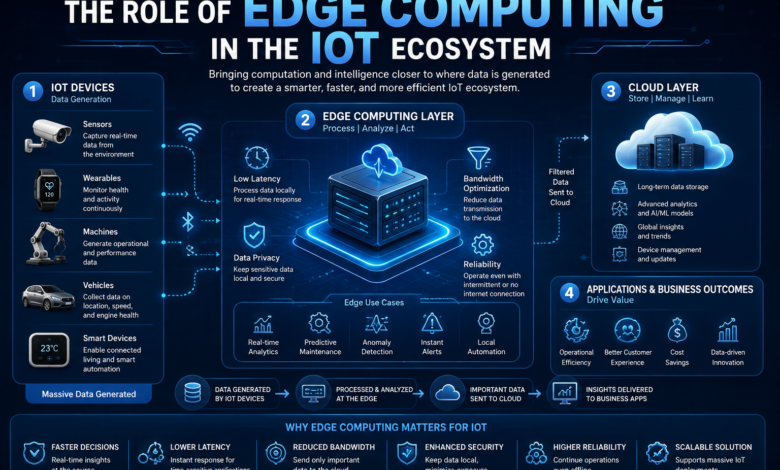
Do you remember when using a “smart” device meant waiting for it to respond? Maybe your voice assistant took a few seconds to answer, or your smart camera lagged when streaming video. Those delays are disappearing fast. With edge computing becoming central to the Internet of Things (IoT), our connection to the digital world is transforming in ways that feel almost magical.
You may have heard terms like “real-time analytics,” “connected devices,” and “smart cities.” But what do these really mean for us? Let’s break it down together, almost like we’re having a casual chat over coffee.
What exactly is edge computing?
Think of edge computing as moving the “brain” of the internet closer to where the action happens. Traditionally, data from IoT devices like sensors, cameras, or smart appliances travels all the way to distant cloud servers for processing. That’s like sending every question to a teacher miles away before you get an answer.
Edge computing changes the game. It processes data locally, near the source, instead of relying entirely on the cloud. This reduces delays, improves efficiency, and makes devices smarter.
Here are the key points:
- Speed: Data is processed instantly, without the round-trip to a faraway server.
- Latency: Almost no delay, which is critical for autonomous cars, healthcare monitoring, and industrial automation.
- Bandwidth efficiency: Less data needs to travel across networks, saving costs and reducing congestion.
Think of it as moving from a single-lane road to a multi-lane expressway right next to your house. Everything flows faster and smoothly.
What is the secret sauce behind IoT devices?
You probably already own some IoT devices — maybe a smartwatch, a smart speaker, or a Wi-Fi-enabled refrigerator. But this is just the beginning. Edge computing makes these devices truly “intelligent.”
Here’s how:
- Local decision-making: Your smart thermostat can adjust temperature instantly without waiting for cloud instructions.
- Real-time alerts: A connected car can detect obstacles and react immediately.
- Smarter healthcare: Wearables can monitor vital signs and alert doctors instantly if something goes wrong.
Imagine this:
- Your car detects traffic ahead and reroutes automatically.
- Your smartwatch informs your doctor if your heart rate spikes.
- Your fridge orders groceries before you even realize you’re out of milk.
All this is possible because edge computing eliminates the delays that slow down device communication.
How will edge computing affect your everyday life?
Edge computing will change your daily routine in ways you might not expect:
- Smarter homes: Lights, appliances, and entertainment systems respond instantly to your commands.
- Healthcare that cares: Doctors can monitor patients remotely in real time. In rural areas, this can save lives.
- Better entertainment: No more buffering. Streaming 8K movies or playing cloud-based games will feel seamless.
- Smart transportation: Self-driving cars, connected traffic signals, and intelligent public transport will make cities safer and more efficient.
- Innovative business: Factories can use edge-powered machines that communicate with each other, reducing downtime and boosting productivity.
This isn’t just a step forward, it’s a major leap.
Why is the world adopting edge computing fast, especially in India and the USA?
Let’s talk geography for a moment.
- India: Telecom giants like Jio and Airtel are investing heavily in IoT and edge infrastructure. This means small businesses in remote towns can access the same speed and intelligence as startups in big cities. For a country with diverse needs, this is revolutionary.
- USA: Edge computing is already powering smart cities, connected cars, and advanced healthcare systems. Companies are experimenting with virtual workplaces, automated delivery systems, and AI-driven retail, all made possible by edge technology.
So, whether you are in Mumbai or Miami, you can see the future of connectivity unfolding right now.
What are the hurdles nobody talks about?
No tech revolution is without challenges. Edge computing faces a few:
- Infrastructure Costs: Building edge data centers and networks is expensive.
- Device Compatibility: Not all IoT devices are ready for edge integration.
- Cybersecurity Risks: More connected devices mean more opportunities for hackers.
- Urban-Rural Divide: Cities get access first, while smaller towns may lag.
But progress continues. As costs decrease and governments invest, these issues will improve just like they did with cloud computing and 4G.
What does the future look like with edge computing?
The exciting part about edge computing is not just one cool device; it’s how everything connects. We are moving toward a system where every gadget, from your car to your toaster, works together seamlessly.
Here’s what’s next:
- AI-powered devices: Smart gadgets will learn and adapt to your habits.
- Smart cities: Traffic, energy, and waste will be managed more efficiently.
- Immersive AR/VR: Augmented and virtual reality will feel lifelike, with almost no lag.
- Industrial IoT: Factories will run on predictive maintenance, reducing downtime and costs.
If the internet was the first digital revolution, edge computing is the second, and it will affect everything.
Why should you care about edge computing?
You might not think you need edge computing now, but in a few years, every app, service, and gadget will rely on it. It’s similar to when everyone moved from dial-up internet to broadband. Once you experience it, you won’t want to go back.
Edge computing isn’t just about faster responses. It’s about creating a smarter, safer, and more connected world.
Final thoughts
Edge Computing in the IoT ecosystem are not just futuristic ideas; they are becoming part of our lives today. The true impact will be how seamlessly they fit into our daily routines, much like how we currently use Wi-Fi without thinking about it.
This is more than just technology. It is a move toward a smarter, more responsive world.
FAQs about edge computing and IoT
Q1. Is edge computing just about speed?
Ans: No, it’s about both speed and intelligence. It allows devices to process data locally and act instantly.
Q2. Will my current IoT devices support edge computing?
Ans: Only if they are designed for edge integration. Older devices may need upgrades.
Q3. How does edge computing improve smart homes?
Ans: It allows devices to communicate with each other right away, with no delay between your command and their response.
Q4. Is edge computing safe?
Ans: Yes, but like any technology, it requires strong cybersecurity measures to protect data.
Q5. How fast is edge computing really?
Ans: It can reduce latency to milliseconds, enabling real-time responses for critical applications.
Q6. When will edge computing be widespread in India and the USA?
Ans: Major cities will see full adoption by 2026, with rural areas following soon after.
For more information visit on our website : Dolphin Techknology